
NOTE: This episode was first recorded in 2021 as a conversation between Robin Jester Wootton and Elizabeth Mindemann on Spiritual Abuse within the church. A lot has happened since 2021 of course but we wanted to pick up a bit where we left off. This episode gives some background for what was going on for both of us in our own personal experiences in church ministry, as pastors’ wives, and as women in the Presbyterian Church in America (PCA) in 2021. Our podcast was called “The Real Women of Church Ministry” at the time and has since been changed.
Transcript below link:
Robin:
Um, so we’ve been on a break for a few months now, right? Like when was the last time, I guess it was right before GA. That was the last time that we recorded together. We’ve certainly talked a lot since then, but GA was the last week of June. And so we had done a bunch of podcasts about stuff that was happening in the PCA and some of the overtures that came up. And, and then we did, we did one podcast or maybe two on being a pastor’s wife. I can’t remember maybe just one. I think it was one. Yeah. And then we kind of took a break mostly because I was on the road as my husband and I decided we needed to just take a break from where we were and we sold our house and we bought a camper van and we traveled 10,000 miles for a little over two months and just traveled the country, which is great and I highly recommend it. It’s definitely weird in a pandemic because, um, every state kind of had its own thing going and we were constantly like mask, no mask. But what do we do? I mean, Rob and I both are vaccinated and, um, yeah, we’ve always been careful about that kind of thing.
But you know, when you get to say Niagara Falls on the fourth of July, which was not planned, we would not have planned it that way. We both forgot that it was the fourth of July. Like when you live in a van for two months, you forget what day it is. And we ended up in Niagara Falls on the fourth of July and it was a zoo. It was an absolute zoo. But, you know, you’re packed in with lots of people from all over the world and, um, you know, you hear lots of languages in every direction, which was great. I loved it. So it was really interesting seeing all the different ways that the different areas of the country have reacted to COVID.
Anyway, all that to say we ended up here in beautiful Utah which was never a place that I thought I’d end up, Salt Lake City. I don’t know much about Salt Lake City other than, you know, obviously the the Mormon community here and that it’s beautiful. I mean it’s absolutely fantastic and the mountains; we love mountains and it’s really nice here. So we’re looking forward to exploring more. Rob is the interim pastor at New Song Church a PCA Church here in town and lots going on.
So we’ve been pretty busy. That’s one of the reasons that we haven’t recorded. But there’s also just been a lot of, what would you say? Sadness, you know, a lot going on in our denomination that has just really kind of given us pause and we’ve been trying to think through it and the conversations we have had have mostly been kind of venting and mourning. So we don’t want to record any of those. Yeah. So, but we were coming back and we’re going to try to put a few more things out there before we get back into anything PCA specific. We do want to talk about what’s going on, but in a little while when we’re a little bit more ready for it.
But today we’re going to talk about something that really, I mean, it’s what brought us together, really. And our first conversation was very much all about spiritual abuse. Yeah. Right.
I think we’ve said it before, Elizabeth and I met on a Facebook group, just commiserating over life and ministry and how difficult it is when you have someone who, a person or several people who, are exerting authority in ministry that makes it difficult for everyone else. And we’ll get more into what I’m getting at. And so we wanted to talk a little bit about what spiritual abuse is, what it isn’t maybe a little, and why it’s so difficult to talk about, to get at, in a lot of our circles.
For one thing, I think we were seeing so much pushback right now in this area in the church, particularly in the American church, broadly evangelical church. People are asking good questions about spiritual abuse, like is it always spiritual abuse when someone says it is? Is it fair to even ask that question of people? And we want to try to kind of get at answering some of that through a lot of resources that Elizabeth has come across and then just kind of talking through, like why is it so hard for our churches to understand that dynamic that’s happening and what can we do about it? How do we move forward in this with wisdom and clarity on abuse itself?
So that’s kind of … we’ll try to do that in like less than 45 minutes. So, Elizabeth, you’ve been doing so much reading. Really, you’re awesome because I pick up a book and it takes me like a month to get any traction sometimes. So, I’m so glad that you’ve been doing a lot of that work. So, I know you’re ready to talk about a few of the resources that you’ve come across and what you’ve done.
Elizabeth:
Yeah, I mean, there is a lot out there, probably more so within the past couple of years. There’s a lot more out there than there used to be. Diane Langberg has been talking about this topic for a long time and she’s a really good resource. I have found her to be super helpful and comforting. She has some lectures online that I’ve listened to several times that have been really helpful. I have not read her newest one, I think, on power, something about power, but I did read her one on Suffering and the Heart of God that has just been really helpful.
Wade Mullen has a book, Something’s Not Right. That’s a, I’m almost, I’m like halfway through that book and that has been helpful. And then in the back of that book, he has a whole lot of resources for people who are going, like recovering from abuse situations, but then also for those who want to walk alongside of people who’ve dealt with abuse. So, and he has a section in there on spiritual abuse for some, some resources there, which has been really helpful.
But then I think, I think I’ve told you I read early on when Tim and I were walking through some really difficult things, times in the church we were in. I read a book called Let Us Prey, P-R-E-Y, and it was mostly on pastors and narcissism. Then I did read When Narcissism Comes to the Church, which is another one that I just read recently.
But the interesting thing about Let Us Pray, like I know there’s some controversy over their study because they did a, it’s like a, they did this like clinical study, and I think it was mostly in Canadian churches, actually, which is fascinating. But, but it still was helpful. I still found it really helpful. I think most people are realizing, oh, and, you know, that podcast that Christianity Today is doing on Mars Hill has been super helpful, I think, in bringing a lot of this stuff to light too.
But I think people are beginning to recognize that there’s something wrong with Christendom evangelicalism in North America, at least. We are looking for a celebrity, you know, like a celebrity pastors, which then makes the church a really attractive place for narcissists to want to lead in because we’re a people that are looking for charismatic leaders who know how to know how to make themselves look good and know how to make us feel special. And it’s not like abuse is one of those things. But I think spiritual abuse becomes one of those things that it’s not, it’s not obvious all the time, the subtle thing until you’re finally like in the moment, like, something is just not right here. And you don’t necessarily have the language to put into it or the ability to speak clearly because you’ve been in it for too long.
And that leads me to the book that I probably found the most helpful in this topic was The Subtle Power of Spiritual Abuse. And they define spiritual abuse in the book on page 20 through 22, in case anybody wants to read it and look at that page. I know my notes that “spiritual abuse is the mistreatment of a person who is in need of help, support or greater spiritual empowerment with the result of weakening, undermining, or decreasing that person’s spiritual empowerment.”
So it’s basically taking someone who’s coming to you that’s vulnerable. And instead of empowering them with the gospel, which is what scripture is to remind them of who they are in Christ, and who God says, you know, what he has for them in the gospel and his love and care for them.
It’s taking that vulnerable person. And it’s beating them. It’s using the gospel and scripture as a weapon against them. And that could take a whole lot of forms. I would further say when you use scripture to justify your abuse or while you’re abusing, that’s spiritual abuse. It’s the use of scripture. And so I think, I don’t know, I mean, I’m not expert in this at all. So I’m only just someone who’s experienced it convinced now that I’ve experienced it and trying to work my way through defining what it is that we walk through and how to avoid it and also not do that to others.
And I think for me, as I’ve been reading through all these resources, I think it’s pretty safe to say you can abuse, you know, like physical abuse, verbal abuse, emotional abuse, sexual abuse. You can abuse in those categories without spiritually abusing.
I don’t know that you can experience spiritual abuse without it overlapping one of those other categories. Because it’s usually happening like, I mean, a most obvious example that people would understand, I would think would be when a pastor is sexually abusing, or a father, a pastor who is a father is sexually abusing his own daughter, and using Scripture, while that’s happening. Now you have an over like you have this layered effect. Now, that’s definitely spiritual abuse, because anytime those girls hear those passages of Scripture, immediately, it’s coupled with with abuse, you know, whether that happens sexually, or whether that’s whether it’s being verbally abusive, or emotionally abusive, you know, all those things, it’s Scripture no longer becomes the balm to heal that it’s meant, you know, it’s no longer associated with God’s Word and his character who he is, and who we are in him, it now becomes a trigger from the trauma and the abuse that you’ve experienced. And I think anybody who’s walked through something with like a narcissistic leader, pastor, and has tried to bring that to light, has tried to talk about abuse within the church, or has tried to have these kinds of these important conversations about what’s not right, something’s not right here. Let’s talk about what’s like what it is, let’s define has this atmosphere, something’s just not right, will inevitably, I think any one of us would be able to say we’ve had a conversation around Matthew 18. Matthew 18 will come up, you will be reprimanded, you will be said that you are flandering, or you are gossiping, because you’re talking about this and you didn’t go about it the right way. Yeah. And I think that’s a common example of spiritual abuse, because you’re trying to talk about spiritual abuse while being spiritually abuse, because you’re told, you’re not allowed to talk about problems, you didn’t go about doing it the right way.
And Tim (my husband), Tim would say, after the fact, this is like, we’re like three year ish, and I’m, I’m still trying to feel from a lot of this stuff. I want to be really careful about how I talk about things, because I am still in, in a place of, you know, like I don’t, I don’t know, but Tim would say now, wish we would have known this then but what we know now is Matthew 18 is, is talking about peer relationship, it’s not talking about a power dynamic. and yet we don’t take that into consideration when we are addressing people who are trying for trying to get help. They want help for the abuse that they’re experiencing and it’s almost inevitably, and Diane Langberg talks about this a lot, it’s almost inevitably a power dynamic. When you have someone who’s in a leadership of a church or a Christian school or a counselor, something like that, there is a power dynamic in which they hold a position of power that the people who are being abused don’t have. That is not a Matthew 18. That’s an Ezekiel 34 situation. Let’s talk about qualifications of an elder and not lording it over people. That is not a Matthew 18. Make sure you meet one-on-one with your kids or students.
Robin
Yeah, it brings us to a good question of why this doesn’t happen in our churches. Why people who are narcissistic, dominant, aggressive people, leaders, are allowed to continue to be in these positions. To me, it’s the question of who gets to say that something is abuse. It’s a little clearer in sexual abuse. It’s a lot clearer in sexual abuse. This is a line that has been crossed and is definitely wrong.
Elizabeth
Yet that’s so hard to do.
Robin
Yes, even though it’s hard to prove for sure, who gets to say, this is what happened, it was wrong, and we need to take action. With spiritual abuse, it’s a little bit more subtle because you have to then start defining. Well, if a pastor tells me that I’m sinning against God, is he abusing me, right? Because we’ve seen that cry and it’s not, we don’t dismiss it. I mean, there’s probably lots going on there. There’s probably a person who, like you’re saying, who went to the pastor for wisdom and counsel and the pastor just kind of lorded over them with scripture, like you need to be doing this and didn’t care well for that person. They didn’t present it well or didn’t develop the relationship enough to build that trust relationship. I think we’ve talked before about like, trust capital that leaders need to build with people, like, and that comes with time and relationship, like a good shepherd will take that time to say, you know, I don’t have to tell this person everything they’re doing wrong, right, like, I need to build the relationship so I can get to a place where I can address some of those issues as they come up, right? And so all that brings us to the question, like, how do we know? How do we know it’s abuse? And that’s just the shepherd doing his job, right? So you have to kind of parse out all of that, like, what is the pastor’s job?
And, and so that’s where we kind of start dividing into all these little, like, factions of what pastor and you have the extreme one extreme, where it’s like, the pastor’s always right. I mean, that’s definitely dynamic, right? There are definitely people who are just like, he’s the man of God, he’s been chosen, he’s been called, he can do no wrong, right? Or maybe he has a bad day, right? Like, it’s that whole, like, he is kind of God’s voice on earth, which is just wrong. I mean, you know, we’re, we don’t believe in the pope for that reason, right? Like, we just don’t think that that’s the case, the pastor absolutely can be wrong about a lot of things.
Elizabeth
And I think that viewpoint gives, like, just the position itself means that this person has the character and that’s not true.
Robin
Right. And that’s an excellent point, because we do kind of say, well, how are we, how are we questioning the character of someone who’s in this position accurately, and over time? Because, you know, some of these guys get, you know, I’m going to be PCA specific here, like, some of these guys get ordained and stay in these positions for 20, 30 years. And I never really questioned about the way they’re, the way they behave, the way their reputation, the community. like any of those things, they’re never asked those things again. And so they’re kind of left… and when you have someone who kind of gained some celebrity and authority and is kind of shielded by people who just think he can do no wrong, there’s that temptation to allow the abuse of authority kind of go rampant. Like, well, let’s, you know, we really, he’s a really great preacher. He’s really good at this or that. Look how much the church has grown under his leadership. And maybe he’s just mean to these people and they really deserve it anyway, right? I mean, it’s that kind of dynamic that ends up, you know, taking hold of our churches. I mean, I could name names. I’m not going to. Yeah.
Elizabeth
And to that point, Robin, I mean, that fit abuse, you know, when we talk about, you could take any kind of course on spiritual abuse and recognize that predators pick churches for a reason, because people in churches are trusting and let them pretty much, you know, I’m very forgiving, you know, I’m like, believe the best, all those things, which are good, but can take be taken to the extreme.
And then, you know, they’re not, they talk about grooming a lot. It’s not always grooming necessarily as they will do things that are like, whoa, to see how much they can get away with and keep on doing that. It’s not unlike some of these, you know, power, hungry, narcissistic pastors. And I think we have to be careful too, because I don’t know that they all recognize that’s what they’re doing, you know?
Robin
Sure. I mean, there’s a lot, there’s, there’s certainly kind of levels spectrum of, of narcissism, which is certainly a huge piece. And what we’re seeing, you know, this idea of narcissism is, has really taken off, and we kind of get this picture of, you know, as Uber Narcissist, I mean, you know, a former president, for example, like, you know, this kind of, you know, I could walk down Fifth Avenue and shoot someone, no one cares. It’s like there’s, we have that in our heads, like, that’s what a narcissist is. And my pastor’s not like that. Right. And so we don’t get other kinds of narcissism that are much more subtle, and that they don’t even recognize in themselves anymore. Like, they just don’t.
And that’s, that’s the nature of narcissism. They, they can’t see it. They cannot. And I really feel like, you know, when we talk about, you know, the, the planks in people’s eyes, this is one of the ways that, that we see it happening in our churches, that some of these guys in leadership have planks in their eyes and they cannot see, they are unable to see the ways in which they’re harming people.
Elizabeth
Yeah. And that is the nature of sin. I mean, we talked about that multiple times, right? Like, I can’t see my own sin. That’s why I need it. you, Robin, it’s why I need, you know, my husband, it’s why I need relationships with Christians, because you can see clearly -clearer and clearly- my sin, but I can’t see.
But with a narcissist, they don’t ever do anything wrong. So it’s almost like, I don’t know, it’s so difficult to have these conversations with them.
Robin
Yeah, yeah. And that’s why, you know, I think one of the other dynamics that happens is that people who are triggered or who have had past trauma will catch on to these things a lot earlier than other people. And they’ll come from a place of kind of an emotional reaction, like I’m feeling threatened and intimidated. that comes through and when they try to express the abuse that they’re feeling, and that gets downplayed. Because it’s like, well, you’re just being emotional, you’re being too sensitive, or, you know, maybe it’s, you know, just your past history that you are reacting this way to this person, or what, you know, any number of those things.
But what we have to get at is, to me, it’s the patterns, right? So if I have one interaction with someone, and I’m feeling intimidated and threatened, and that in and of itself is worth looking at and discussing.
But if a leader has continual patterns of multiple instances with multiple people who are all saying the same or similar things about that person, that is a clear warning sign of abuse, of spiritual abuse on that leader’s part.
Because it’s the, if you’re not looking for those patterns, and you just take one isolated incident, it’s like, yeah, you know what, yeah he probably did just have a bad day or whatever. And so we kind of excuse that, like, okay, just, that was not… that’s not worth really even thinking about.
Well, if we had that instance, and then a few weeks later, we have this other thing that happened, and it’s like, well, right, so so we start building this case in our heads, like, you know, there’s this, like, the celebrity status of a lot of these guys, they have some power and authority, and they tend to not be open to any kind of rebuke. Those are patterns that we start seeing over and over again, as we start looking at at some of these people in leadership, and that’s what we’re talking about we’re not talking about these kind of isolated incidents that happen. We’re talking about people who have these behaviors over and over and over again. And, yeah, and it’s important to make that distinction.
And when we’re, when we’re asking for accountability, because when, by the time, someone who is a victim of a spiritual abuser comes to say a session and says, “Listen, this is happening,” you can bet that we’re talking about years of abuse. And, and then having to prove all of that having to have some kind of way to lay out the patterns. Then, then to someone who’s not trauma informed, someone who’s, who’s going to just take, you know, give the benefit of the doubt and all that kind of stuff like they’re, they’re going to push back like, well, you’re just, you know, you’re petty, like, “you have all this stuff written down? You’re petty.” Right? Yeah. You’re not forgetting.
Elizabeth
You’re keeping a record of wrong.
Robin
Yes. You’re not being loving you’re not, you’re not forgiving. And so we’re kind of caught in this vicious cycle, aren’t we? Because then it’s like, well, what do we do with that? And that in itself is a kind of spiritual abuse, right? I am trying to understand how this person is allowed to continue in the position that he’s in and not be called out on it in any significant way.
I mean, yeah, we’ve seen it happen. We’ve seen some of these guys just, all right, this conflict and then they just go on and go to another church. I mean, I wonder if any church search committees are asking these guys, like, have you ever been accused of spiritual abuse? I mean, maybe that should be a question on, on every church committee, search committee. Like, tell, tell me what your thoughts are on abuse of authority in the church and, and how, how would you handle it? I feel like everyone should be asking that, of their leaders, because if…
Elizabeth
Yeah, I agree. I was going to say with your, you brought it up too, like the accountability piece, it’s definitely pattern. It’s definitely patterns of behavior. So that’s the first one. And if you don’t, also, it’s not this way with every person they interact with. Yes. That’s the key piece too. So you can’t go by the fact that, well, the so-and-so says that he’s not this way. So like, you must be a problem because he’s that way with you. Because that’s the pattern of abuse to begin with. That is part of it. People do not abuse everybody that they have relationships with.
And then the accountability aspect of it is, there’s often this facade in which it’s like, well, yeah, I’ve set up my accountability, but you have to dig deeper to find out, are these, are these just yes men?
Or are these people that are actually challenging? Because when you have someone who comes to your session and says, the pastor is spiritually abusing you, and here’s two years long of evidence, like of all the things that have happened to me, that same two years that man has been working with that session and developing, you know, like a relationship with that session and showing like, and for lack of a better word, I don’t want to say manipulating and, and grooming, but he’s, he is developing within them, a group of men who see a certain side of him. And so what this person is coming in and sharing with them doesn’t fit with that side. And then when that person leaves, he’s got full access, again, to this group of men that’s like, you know, “you know how she is, you know, she’s, she’s got this, you know, she’s been abused before.” So, you know, “she’s just super sensitive,” or, “you know, she’s a woman who’s very strong personality, and, you know, how her marriage is, you know, like, she’s one of the worst fans in the marriage.” So, you know, “she just can’t handle a strong man,” or that’s, that’s often, I mean, in my, in my situation, it was like, any kind of voicing of concern, or asking questions, even, was turnaround to focus on me or the person who was asking this question, as if you shouldn’t be asked, and why are you so angry, and really be careful with your tone, and, and questioning your marriage relationship, like, you know, oh, anyway, so the accountability thing, I think, is important to recognize, you can’t just say, well, he has a group of people that are holding into account, because if they’re just a bunch of people who agree with him and never push back, because anyone who pushes back suddenly isn’t an elder anymore, then you don’t have a group of accountability.
Robin
Yeah. Yeah, and I, um, the book, Paul David Tripp was, he wrote a great book called Lead, L-E-A-D, and he talks a lot about accountability, and how we kind of, we’ve made, we’ve made accountability groups, like, it was big when I was in college, I remember, like, everyone talking about, oh, you need your, your court of three, or whatever, remember that, it was like, you have two friends that you tell everything to, they keep you accountable, and we kind of made it like it’s that like personal like okay I have people keeping me accountable because they pray with me they ask me about my sin we talk about it and then and then it kind of that’s it right that that’s what accountability is to people and that’s good I’m not -please don’t get me wrong; that’s a good thing to do – but it goes a step further particularly with leadership and so with elders the accountability piece is not just owning the things that you’re doing wrong or you know talking about how you’re weak or your failures because here’s what happens is that abusive elder narcissistic elder will come to their session and say “I you know I’m a sinner. I’m weak. I, you know, I give in to my my temper” or, you know, whatever the the different things that they’ll say. and you know “pray with me that I don’t give into those things and that I trust in God” and they say all the right things, right.
But the accountability piece says okay you’ve you’ve recognized these things in yourself and we’re going to hold you to it. And that if you’re continuing to develop these behaviors or continuing to allow these behaviors in your interactions with people and you’re continuing to have this, you know, be known for your temper, for your arrogance, for your misogyny, for your racism, right? Like, if these are things that are coming out, then we need to have a conversation about whether or not you’re fit to be a pastor, right?
Because accountability isn’t just “yeah those things are bad. Stop doing that and let’s continue on with ministry.” That’s not what real accountability is and, in his book, Paul Tripp talks about that a lot like we’re doing our pastors harm by allowing them to continue in their positions when they have real work they need to be doing to get healthy. And you’re saying like just having yes men who just kind of say, you know, “this guy – we’re going to support this guy no matter what” are losing. They’re losing out on real ministry because whatever good the ministry is doing, it’s being undermined by all the damage. It’s being … we kind of look at “oh, well, look how the church is growing” or “we have such great programs” or “he’s such a good preacher” but we’re completely missing out on the piece where he’s crushing people and, you know, there are people that are walking away in despair. Because we can’t… it’s not like a, well they’re just kind of collateral damage. There’s no such thing in the church, right? Like, you go after those people. We don’t let them just walk away without any effort.
Elizabeth
So, the sheep are scattered. That’s what’s happening. And, and the shepherd’s job is to care for them, not to be the one scattering them and crushing them and, like, to your point, Christianity Today -you know that the whole podcast with Mars Hill- it’s not just about Mars Hill. They’re talking about a systemic problem. I know we may have a problem with that word, but it just means that there’s a problem within the system. You know, thinking through that it’s not just about Mark Driscoll. Mark Driscoll was bragging about running people over with the bus, you know, and leaving this wake of dead bodies behind him. If you’re not with me, you’re against me. If you’re not on board, you’re, you’re done – like that mentality is not just we’re treating church like a business model. Like this is a leadership style. Oh my goodness, if I could hear how many times I heard that this is just his leadership style. Then he needs a new one because pastors can’t have that kind of a leadership style. You can’t be caring for the people, spiritual wellbeing, physical wellbeing of the people in your community, in your church, the congregation that you’re charged with in a way that treating them like they are just expendable. Like we can just run them over and, and that we have a vision. And if you’re not on board with this vision, then, then this isn’t the church for you or you can just leave or, and then what ends up happening is people aren’t just leaving churches. They’re leaving Christianity completely because they’re associating that kind of behavior and that kind of mentality with Christianity. And they’re, it’s, I don’t believe that this is solely their fault because when they look at around them at the big picture in this country, that’s kind of what we’re seeing.
Robin
Yeah. Absolutely. And, you know, it’s, it’s because we, we miss the piece of like, it’s, it’s this person, like say a market just go it’s kind of driving the abuse, but it’s all the enablers around him that create the environment that lets that thrive. Right? Like it doesn’t happen in a vacuum. It’s, it’s all, all together, the system itself is, is one that allows it to allows the abuse to continue, and and never it just it goes unchecked.
You know, we’re we’re looking at a case now in the PCA that it’s like there’s this guy who’s been accused of abuse like serious abuse by multiple people and and somehow the presbytery is like well… let’s look at this again, right? Like how how does that happen?
It happens because there’s a system in place that is I mean … I could go off and I’m not going to, but it’s the system that’s in place that just doesn’t recognize the damage that’s been done. I mean, they don’t believe victims for one thing. There’s a whole other thing. But because we want to believe the best in our pastors, we want to, and our brains will do everything we can to make it so, to make it that he’s not that bad of a guy, and if he’s charming, and if he’s able to win the crowd, then you end up with a guy who’s just been enabled to continue to feel like he can do no wrong.
And what do you do with that? Where does that person go with that?
Once you feel like you’re invincible, what do you do with that power and authority? Who is capable, as a human being, to take that kind of enabling and not rampantly abuse it, right? It is our human sinful nature that we are constantly fighting against our own sense of importance, and our own sense of, you know, some weird infallibility, like I am the standard for all things.
And I think the piece that really we have to look at is is the humility of good shepherds, that humility drives good shepherds to constantly check themselves, like “am I right now doing what is best for this other person, not doing what’s best for me, or saving my own.” Right? Like it’s, I want to do what is best for the sheep and lay my life down for those that I’m called to serve.
And, and we just we find over and over like, you know, right, right now we’re in this kind of pattern of reaction and overreaction. And so, you know, it’s like the pendulum swinging back and forth, like let’s that like go all out we want everybody’s heads on platters, right? Which isn’t necessarily, you know, we see it all the time now like anyone who’s a pastor has a big target on their back right now. And so pastors you know, your husband, my husband, we are… they’re constantly having to be super careful – which they should be anyway, right? I mean that’s not a bad thing, but they do have to be constantly super careful about how they exert their authority.
And then you have the the pendulum swing way the other way and it’s like we’re gonna throw out all this stuff because you all are just bitter angry people and you think you’re “victims” all the time and you know they use the air quotes, and, you know, it’s like we’re just gonna react way the other way and be arrogant jerks about it, because we’re just afraid of … and we’re afraid. We’re just afraid, right? So. we’re gonna react to that way instead of some kind of more reasonable, you know, dare I say, middle ground of like, let’s do the work of figuring out who, why some people are getting away with abuse, right? Let’s label it for what it is. Call them out on it, hold them accountable.
The good shepherds, the ones who are humble, the ones who have the church at heart will say, yeah, you’re right. I haven’t been thinking about the way I use my authority. And I maybe need to step down for a bit and get emotionally healthy. Maybe I’m reacting to all the things that have been happening in the past few years and not doing a good job of listening to people.
But then the arrogant ones, the narcissists among us are gonna push back. And they’re gonna, they’re gonna fight. They’re gonna, you know, sue people in the courts. They’re gonna do all kinds of things that will show their hand. I mean, to me, it’s all evidence of where their heart is.
And, and so all of that needs to be taken into consideration. And I say on the presbytery level, like personally, I don’t think, and here’s where I got off the rails, like, I don’t think any session is really capable of tackling spiritual abuse in their own church. Like, I really feel like someone needs to, and I’ll be honest, I’ve changed over a little bit on this, because a few years ago, I would have said that I think the session should be able to deal with it in house.
But boy, I’ve gone through some things now where like, maybe that’s not really the case. Maybe that’s not what is best for everybody involved for multiple reasons. But when there’s accusations against the pastor, I feel like we need to bypass the session altogether, to be honest. I think it goes right to the Presbytery. Yeah, the Presbytery isn’t perfect, because we’re seeing that right now. You know, the Presbyterian is not necessarily going to be really able to parse through all of it and remove, you know, personal relationship like, well, this guy, you know, like you said before, well, this guy doesn’t seem like that to me. He seems like a really good guy, right? So I’m not going to believe anything negative about it. All of that needs to be removed, right? And so at the Presbyterian level, we need to train these guys on, first of all, trauma-informed practices to help everybody involved, victims especially.
And then we need to be able to say, here’s what we’re looking for. Here are the flags that you’re looking for in in the ministry in the way that that sessions are operated in the way that the pastor conducts himself and then we need to have clearer guidelines on what to do because we really don’t like. The BCO is not real real real clear on how to proceed when a pastor is involved and so it gets kind of dicey and, believe me, we’ve -my husband and I- have looked through the BCO on these things, um like, what are the options for churches. And there’s not a lot …there’s not a lot of work done on how these things should go forward and unfortunately, I mean, here we are back at… I said I wasn’t going to talk about overtures but unfortunately all the overtures that were dealing with investigations were kind of pushed aside for next year, which, you know, this maybe wasn’t the year to attack it all, but I feel like there’s a lot of cases out there right now that could benefit from all of this. Like how do we, um, can we look at past investigations in our presbyteries and learn from how it was handled and then say, uh, you know we need to do better? We need to figure out a better way of handling accusations like this that doesn’t do more damage in the long run than it could have, right?
I mean you know people who have kind of pushed back on the spiritual abuse thing, I’ve been telling people read Ezekiel 34 and read Matthew 23 and compare and contrast them to what we’re saying. Like the shepherds in the old testament and I love, I mean, I love God, right? I love God. He’s a pretty good writer and so he’s like come up with some good stuff and so you look you look at the old testament. Like, if it was just the old testament passage, we’d be like oh that’s that’s that’s right?
But then it was just the New Testament passage, we could also do different things with that. And so God was like, let me give you two passages that are similar, and that are speaking to our leaders today in our churches, like, these are the things that you’re doing to your sheep. And, you know, most, most pastors would just be like, yeah, no, we’re not doing those things. So how are we doing those? How, how are we, you know, abusing our sheep? How are we not protecting them? Or how are we taking their, their finest meats from them, right? Like, we’re not doing those things. But when you really kind of investigate those two passages, and think through everything we’ve talked about, the angle of the narcissism, the lack of empathy, which is a whole other thing, you know, it’s, it’s all pointing to our churches today and everything we’re seeing in our churches.
Elizabeth
I think you bring up a really good point, and we’ve talked about this before, about how when accusations are brought up, when there’s the conflict, when there’s the person coming forward and finally saying, you know, I am uncomfortable with the fact that that’s happening, I think we need to take a crucial look at the pastor and how are they responding to that.
Because often in these cases, first of all, are they welcoming an investigation? Do we believe in the total depravity or do we not? Do we believe that the struggle with sin and sanctification is a process and that I have logs in my eyes and that I need to be continually having the Spirit work through sin within me? Do we believe that about ourselves or do we not? Do we concur with sessions that write letters to victims that say there is no evidence of sin in our ministry? Really? Is that really where we’re at or do we welcome the investigation and say, you know what, I know that there’s sin within my heart and I know that I’m not always the best communicator and I know that my point, you know, I’ll use the example that I fully expected that when I took the stories that I was being told from people that I loved and cared for about interactions with a pastor, when I took those stories to him, I fully expected the response to be, “I had no idea that’s the way people were perceiving me. What can we do about this? Like, let’s, let’s try to work through it. And you know, I, I am like, totally broken that somebody would walk away from an interaction from me feeling this way.”
And it was not at all like that. Completely the opposite. “There’s something wrong with them.”
So I think we need to look at how they interact, like we need to look at the reaction. You know, you, you address that with the humility piece, how they react, you know, to the investigation and recognizing that we have to give grace to everybody involved.
But that doesn’t mean, grace doesn’t mean we don’t follow through on investigation. Grace means for the sake of everyone involved, we continue with the investigation. And what pastor would not want an investigation to go all the way through so that they could repent of what needed to be repented of and be cleared in areas in which they’re not at fault.
You know, I would think anybody would want and welcome that, especially if you have relationships with the people in your presbytery, especially if these are men you do ministry with and you trust them, which it should be that way.
We also we also have to talk about the fact that I don’t know that every presbytery has a shepherding committee. The presbytery that I’ve been in have shepherding committees. But we’ve got to really kind of discuss that I think amongst our churches and presbyteries and recognizing that having a shepherding committee come in in the PCA, having a shepherding committee come into your church to help you deal with different situations does not mean you’re a problematic church. Like this isn’t a negative thing. This is a help for you to come alongside of you. Because in our situation, and we’ve heard of other situations in which there was asked for the shepherding committee to come in, or it was asked for third party mediation, and that was refused by the session, because they’ve already had the presbytery shepherding committee. Like “just two years ago deal with something, we don’t want to bring them back in again, we’re a problem church.”
But that’s not it. It’s not it. We have to talk about it differently than that. It’s, it’s, you know, we’re all in this together, we are all in this together for the sake of the gospel, and for the good of the church.
And so I think we, I think we don’t recognize sometimes the way we talk about things. And so that it we have the process to go through, but we don’t access or use the process, because we think that going through that process means that we’re a problem.
Robin
Yeah. So that… it’s true with church discipline, right? Like, we would wait until there’s some kind of charges to perform any kind of church discipline, whether formal or informal. And so we need a bigger picture of how we’re like, the way that we ask for accountability from members, church members, any old church member, right? Like you have certain vows that you’ve taken and if something happens, we’re going to call you in. It’s like getting called to the principal’s office, right? Like you did something wrong, now we have to discipline you.
And I feel like we need a more proactive approach than trying to put out fires. Like we’re not, we certainly are going to put out fires. There’s always going to be fires, but you know, one of my biggest intentions, whatever, with the way a lot of presbyteries work, it’s like, you know, we do have these committees, but all their time is being taken up by problems, right, like, because they’ve gotten to be problems because they’ve been let go for so long. And so, you know, if you’re not checking in with healthy churches, and I hate to be so pessimistic, but it’s only a matter of time before every healthy church has something unhealthy happen, right, like, you can have the most healthy, growing, vibrant church, one year, and then, you know, say 2020 happens, right, and then you have an unhealthy church all of a sudden. So not checking in, I mean, it’s kind of like a well being checkup, right, like, when you have a baby, you bring your baby to like 500 checkups, right, like, that first year, it feels like every couple weeks you’re bringing your baby in to look at something.
And in a lot of ways, like, we need that model for our churches, and for our elders, like, what are we doing to proactively say, like, how do we get at where the problems could be, like, are there good resources for having some kind of checklist of here are areas that that all churches struggle in? And then here are areas, excuse me that may that may be specific to your church, right, like, how do we get at that information. And then, how do we kind of check in, you know, the shepherding communities to me should be making the rounds like calling every pastor and their pastor, they have a list, like I’m going to call you every third Tuesday of the month and check in with you. And it’s not going to just be like, you know, hey, how you doing, you’re doing great, God bless you, it’s, it’s going to be, you know, what are you struggling with, what do we need to, can we step in on something, can we point you to some good resources, that kind of stuff.
I mean, that’s the very least and minimal that but nobody wants to do that it’s a lot of work. It’s a lot of work. right? Like everybody’s so busy doing their own stuff in their own local churches that it’s so hard to to get the time and the energy and all that to to do something well.
So maybe it you know there’s a whole other way to do these things and you know I’m kind of you know I’ve talked about this stuff. I’ve written up some some different things in the past. I should pull that out again because it probably has changed a little bit because you know when we first got married there was there was a lot of stuff going on for my husband in ministry and very few people in the Presbytery reached out to him or anyone to say, hey how’s that going? Like you’d come to Presbytery and say here are the things I’m struggling with. It was like oh we’ll pay for you and then you don’t talk about it again for three months, right? and if at all, right. And so there’s no real good mechanism for that at the press tray level of saying how do we do a better job of being proactive about some of these things and not letting it get to the point where suddenly we’re doing a full-on investigation.
Now in some cases where beyond that, there’s already you know several places I can think of where it’s I mean you know a good example to kind of bring it around again is you know what’s happened with Greg Johnson, right. Like he was brought up on charges, he was, like, “okay let’s do this. Let’s investigate. Come talk to me. Let’s do it.” Three times, right? I mean it’s uh and the press chair cleared him and then they were like, no, we’re not, that’s not good enough. Let’s bring him up to the SJC.
And so it was… as painful and awful and hateful and agenda-driven as it is, it’s kind of like, well, now we know that that can happen, that that does happen in the PCA. We know that we have the mechanism for that, right? There is …
Elizabeth
Yeah so tell me why that’s not happening with pastors who are abusing their power, pastors who are sexually abusing the women in their congregation, pastors who are… yeah, tell me why that isn’t happening.
Robin
Exactly. That’s exactly right, because then we’re at a loss where those of us who have been been through these situations. It’s like, you know, that’s a whole other hour conversation of why why people are going after Greg so hard, but, um, you know. It just, it just shows the hypocrisy of the system like we’re gonna protect certain people; we’re not gonna protect other people. And if, you know, if a denomination keeps keeps making decisions that kind of, you know, affirm what we all fear and suspect, then we have to believe. You know, it’s that saying, if someone tells you who they are, believe them, right? Yeah, yeah. And so we, that’s kind of where we, where we end up with this whole discussion on spiritual abuse, like we know we can all agree, I think we can all agree, there’s probably some people that wouldn’t.
Anyone with power is at risk of abusing it. It’s just, that is human nature. It’s our sin nature at work, you know, to geek out that that line in the matrix height that Oracle says, “what do men with power want? More power.”
And so it’s kind of that constant struggle to take the power that we’re given and and mitigate it with humility and kindness, and to make sure that we’re putting in place the systems that keep us in check, that keep us in true accountability, so we’re able to lead well, we’re able to repent well when we do abuse it, and we’re able to call each other out on it, and to be able to say, hey, you know, I mean. I would love for people across the PCA right now, there’s so many pastors who are really just hurting and reeling from all of the craziness, like, I mean, we could go into that, like, you know.
We’re talking about pastors who are abusive, but then what about ruling elders, like, there’s ruling elders who are abusing their pastors, like, who hold this, like, lordship over them. Like, “hey, we pay you,” right? “You’re on our payroll.” It’s that kind of feeling, like, “you work for us,” right? “You can come and go,” you know? And there are elders that have basically said, I mean, they’ve said all kinds of things to pastors! It’s like, oh my gosh, like, how is that, how is that okay? How is that an okay attitude to have towards your pastor, but that’s a whole other, I mean, we could talk about the tensions right now between ruling elders and teaching elders and this kind of division of labor or whatever, but there’s all kinds of rampant abuse in that dynamic of sessions that just gobble up their pastors and spit them out, right. And you pay attention to any church that has had multiple different pastors over the years and we have to you know, what is that about? And can presbyteries take an honest look at that, like what’s happening in the churches, in our care, under our care, under our watch that are just getting destroyed?
There’s so much to unpack here, but I do wanna say that we’ll put together links for the resources that we’ve mentioned, some of the people that we’ve mentioned.
There are people who are doing, and like you said at the beginning, there’s a lot more resources than there have ever been, which is great. And I’m so thankful.
I mean, one of the biggest pieces of trauma from spiritual abuse is that you do feel like you’re alone. You know, the loneliness of being abused is one of the biggest pieces for me. Like I don’t know who to trust. I don’t know who to talk to about it. I don’t know who knows what.
And all of those things just add to the trauma that victims of abuse have to endure as fallout from all that. And we can certainly talk about that at another time, like just some of the resources that victims need to have for healing and to be able to go back into their churches or to a new church. And- Any church.
Elizabeth
Any church, yeah.
Robin
Because it is like, and the example you gave of pastor father who abuses his children and uses Bible verses and the trigger that that is, like it doesn’t even have to be that. Like, I mean, I have in my own story, you know, in the past couple of years, everything that’s happened to us, like every time I walk into a church building for worship, it’s been a struggle.
Like it’s, you know, I want very much for the church to be a safe place for everybody. And I’m constantly thinking, like, I don’t want to say too much. You know, like, I don’t even want to see, like, if I start crying, I feel super, you know, triggered. Like, you know, I just, all of it just kind of works against me. And just being able to come into worship and just worship. And that’s been removed from, from me because of all of what has happened.
All that to say, you know, having people in leadership who don’t take ownership of that or don’t recognize their role in causing that is the problem. I mean, that’s the problem that we’re talking about is that people don’t recognize the log in their eye of how they have contributed to the environment.
Elizabeth
Right. That allows it to happen to people. Yeah. I know when you bring, you brought up the whole triggering thing and I know that people hear certain words and phrases and automatically they kind of shut down like that’s just cultural. That’s like whatever we want to call it. They think safe places are, you know, safe places are mocks and people are too sensitive and, you know, everybody’s triggered and then you think of it meme of, you know, that are out there of people who are like eyes wide and just shaking.
But I think if as Christian we’re really willing to follow our savior, as we’re called to be, and to love God and to love our neighbor as well. Part of that means digging deeper into this vocabulary and investigating what is it that we’re actually talking about and are these realities, and that triggering is not just some like hot topic or buzzword, you know, hashtags or whatever that’s out there. It’s real.
One of the books I read soon after we moved here was The Body Keep Score. And it was really good and helpful for me to understand why my body was reacting to things that I pride myself. And there’s a key word pride myself and I recognize that that’s not necessarily a good thing, but I pride myself as being someone who is in control.
Part of that is being a female and growing up in an environment in which females are often dismissed because they are too emotional or out of control. I pride myself as being someone who is very much in control of my environment, my emotions, the way in which I talk about things, you know, I keeping control of like my tears, all of that.
So much so to the point that like I share this story a lot with people because it was the first time that I think I realized really what triggering is. And so I had gone to an event with a friend, and I can’t remember if I shared that. I don’t think I shared this with you, but I had gone to an event with a friend and I saw someone across the room, and there were a lot of people there. I saw someone across the room and immediately I started to cry. I didn’t recognize that person at first, like nothing. And I’m like, what is happening to me? This is so out of my comfort zone. Find a bathroom really fast, get yourself together, Elizabeth, What is going on?
The person I saw across the room then was one of the speakers at the event. And as she was up there talking, I realized she was my nurse when I had our first miscarriage. And it all started to come back to me. It was like my body recognized who she was before my brain caught up with it.
Robin
Wow.
Elizabeth
And that was, that’s like the clearest example I can give of like a triggering thing. So when you’ve been abused or gone through a traumatic event which losing a baby is a traumatic event, you know, that will forever stick with me. Your body is, keeping score for life, you know, that’s why it’s called that of what’s going on. And so when you find yourself in a situation that is, for whatever reason, similar, or recognizes that trauma, there is oftentimes when your body will respond, and you have no control over that, that’s what triggering is.
And it happens to us, it happens to all of us, you know, and, and abuse. I think we can talk about this, because it’s been said to me, “Well, everybody abuses everybody. You know, because that’s what sin is.”
And that was said to me, like, in a counseling aspect. And, and so like, we have to be careful not to overuse the word abuse, because everybody abuses everybody there, they’re in relationships with. And well, on one hand, okay.
Robin
Yeah, sure.
Elizabeth
On the other hand, and a much bigger point is the patterns of behavior we’re talking about, we cannot dismiss. We cannot dismiss people treating others in inhumane ways, particularly in the church, it’s dehumanizing, and victimizing them and making them not be able to step foot into a church building, because the church itself now becomes a trigger for them.
We can’t allow that. And I think you brought up, you know, Matthew 23. I was looking at it to see, I can’t remember if it’s in that passage or not, where Jesus, you know, Jesus talks about spiritual abuse. So you can’t say it’s not a thing. But it doesn’t happen. Because that is what Pharisees did. That is exactly what the teachers of the law were doing to the people. They were, instead of using, instead of shepherding the people, when Jesus comes on the scene, they’re adding burdens to that, you know, and we, we tend to talk about that, I think, in our circles, it’s like legalism. You know, we’re not legalistic, you know, we don’t have all these outside laws, extra biblical expectations, blah, blah, blah. That’s legalism. But we do the same thing.
That’s what spiritual abuse is.
It’s adding burdens, it’s adding extra biblical expectations on people who are already vulnerable and hurting. And I think also you bring up a good point too about the recognizing that all of our pastors are exhausted, you know, right now. And so we need to have grace. I just keep coming back to the fact that we’re talking about people, we’re talking about patterns of behavior and you’ll know that. If you talk to enough people, you’ll know that.
Robin
Yeah, and that brings up a good point that I think we have to add in. Abuse is not always about intent. Right? Abuse isn’t always about intent to abuse, right? So there will be people who need to make that those steps of saying, well, he didn’t mean to do that. And so that excuses it, or it makes it not abuse. That’s not the point. The point is that it was abusive, regardless of whether he intended to be abusive or not. Now, if he intended it, that’s a whole other story, because then you’re getting more into, you know, the narcissistic approach to, you know, some pastors think they can do no wrong, right? Or they’re just sadistic, which is a whole other level of problems, which I’m not saying that doesn’t exist, because I think it does. And I can, yeah. Anyway, the point was that, you know, we tend to excuse things that happen that do harm, because that’s not what we meant, right?
And so we need better ways as a church to to navigate that, like, just because you know, like I said, like, just because it wasn’t meant to harm someone, it did harm someone. And if it’s a pattern that this particular person has with multiple people, then it becomes enough of a warning flag to say, we need to talk about this, we need to address it, maybe actually bring up charges, maybe actually ask the pastor step down and get counseling, right? Because if that person is not seeing their patterns of behavior and how it’s affecting people, then that’s a much bigger problem. You know, I can think of one ruling elder who we’ve dealt with in the past who, man, he had the reputation and everybody knew it, but nobody ever wanted to call him out on it. It wasn’t until after we left that it actually happened, which I’m glad something happened. But, you know, it was this kind of idea, like, well, he’s a good guy, he means well, you know, and he’s been serving the church for so long, and he was a nice enough guy, right?
I mean, it’s never the guy that’s like, awful, right? It’s always the guy who’s like, you know, charming and winsome and seems really spiritual, right? And so, so he was given a pass for many years because it’s like, well, he doesn’t mean to, he didn’t mean it that way, or he was, he’s not that bad, right?
Yeah. But the intent of… of it isn’t really the question.
Elizabeth
What’s the impact and we have to deal with that. I think to your point, that’s one of the things I’ve had conversations multiple times with people about is intent matters and it doesn’t matter.
And I think this is where we have to understand even Old Testament. We look at Old Testament sacrificial laws and practices and repentance and all of that and God provided sacrifices for both intentional and unintentional sins. And repentance needs to happen for intentional and unintentional sins because regardless of whether you intend to run someone over the bus or not, you ran them over with the bus and you got to deal with the healing. You have to repent of running them over with the bus and now you got to work on the healing aspect and make sure you’re aware of what caused you to run the bus over them in the first place. Because you don’t want to just keep doing that and say, well, I still didn’t mean to because then you got like manslaughter all over the place because, well, no, you still have to work through the repentance and the healing process and all the things that have to happen because of our sin, whether it’s intended or not.
Robin
You know, I think a good place to kind of wrap up this piece, like I do want to come back to maybe talking more about trauma and about what victims can do to get to a better place of healing.
I’d love to talk more about, you know, in the PCA, we have a lot of work to do. I mean, across the board for so many reasons, but, you know, kind of unpacking this idea of like, you know, how do we let these things go for so long and get to a point where we’re having stuff on the front page of the local newspaper and what’s the environment that allows that to happen?
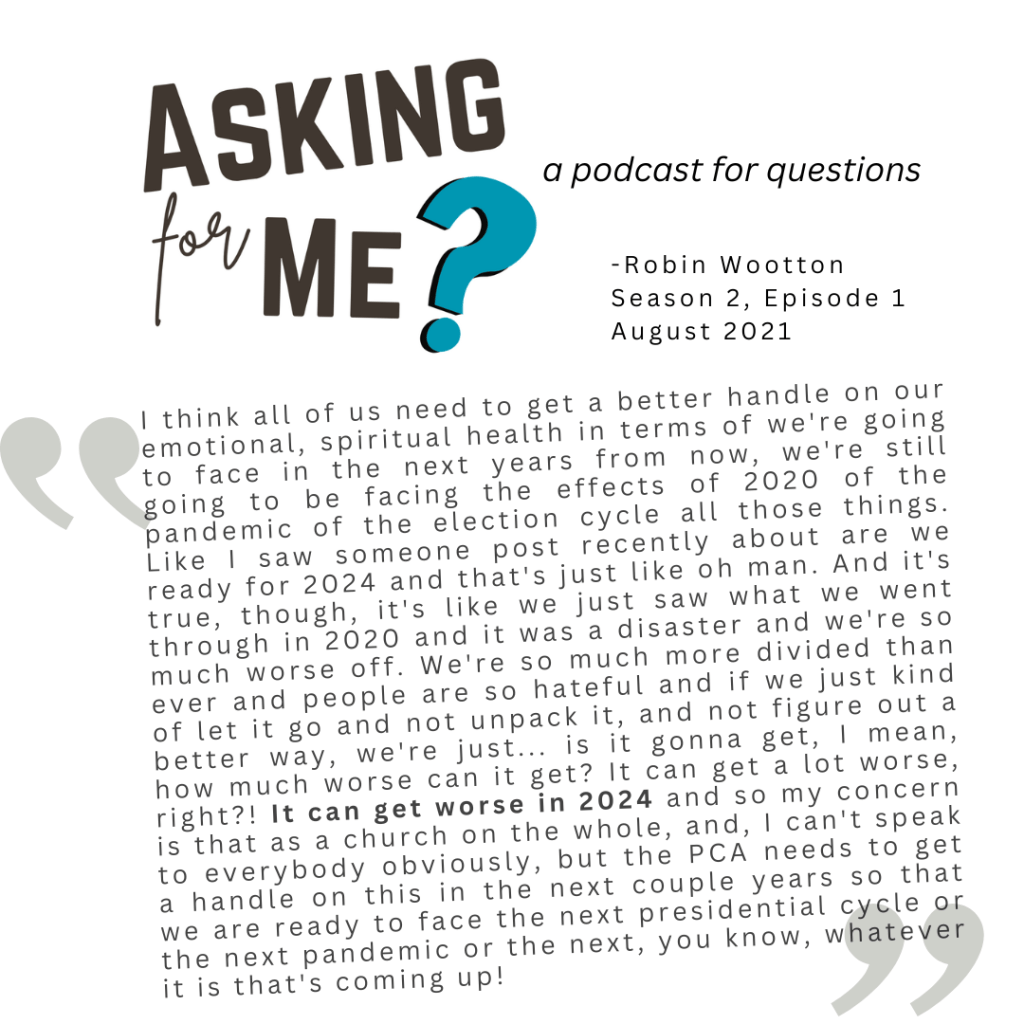
I think we have to look at that as a whole. And then for… I have a good thing through, I know for me, my own trauma and it’s not just what happened these past two years, though that certainly is a big factor right now, I think all of us need to get a better handle on our emotional, spiritual health in terms of we’re going to face in the next years from now, we’re still going to be facing the effects of 2020 of the pandemic of the election cycle all those things. Like I saw someone post recently about are we ready for 2024 and that’s just like oh man. And it’s true, though, it’s like we just saw what we went through in 2020 and it was a disaster and and we’re so much worse off. We’re so much more divided than ever and people are so hateful and if we just kind of let it go and not unpack it, and not figure out a better way, we’re just… is it gonna get, I mean, how much worse can it get? It can get a lot worse, right?! It can get worse in 2024 and so my concern is that as a church on the whole, and, I can’t speak to everybody obviously, but PCA needs to get a handle on this in the next couple years so that we are ready to face the next presidential cycle or the next pandemic or the next, you know, whatever it is that’s coming up! To just kind of ignore these things, like the abuse of authority, is just going to continue the patterns forever. It’s just going to be this vicious cycle and we can’t. That’s not the gospel. That’s not God, God’s work in the church.
and my kids just came home from school. Hi!
Elizabeth
How was school?
Robin’s child
Good and we also got cookies!
Robin
The school is right next door to a cookie shop which is brilliant.
Say hi!
Yeah every school should have a cookie shop next door.
Elizabeth
Yes. That should be a requirement!
Yum!
###


Leave a Reply